

Natalia Kirilova on threatened business models and the new reality of the Bulgarian market
The advertising sector in our country is undergoing a massive transformation, marked by pressure for lightning-fast results and the devaluation of creative labor under the influence of new technologies. We speak with our CEO, Natalia Kirilova, about how these new trends are affecting the advertising business.
What is currently happening in the advertising business?
My general feeling is that everyone – both clients and advertisers (even if we don’t show it to each other) – is “looking around” to see what will happen next. Changes are happening extremely fast, sometimes we don’t even realize them and the fact that we’ve accepted them as part of our work. The pressure for optimizations and results of every kind is immense, and this inevitably has a destructive effect on creativity and the free financial resource in media and agencies. Advertising content is turning into cheap fast-moving consumer goods – without loyal consumers, with a short lifespan, low price, and often questionable quality. Large-scale projects are becoming an increasingly rare occurrence.
How are new technologies and AI changing advertising today?
Over the past two years, advertising agencies in our country have been extremely sensitive to the topic of artificial intelligence. And rightly so. AI creates the perception that it can displace a number of activities in the sector – from copywriting and design to media planning. Although the effect is not yet fully felt by everyone, there is actually a large number of independent specialists on the market, including people in high positions in media and agencies who until recently were decision-makers. This shows that the transformation is already underway. Artificial intelligence significantly optimizes work time, but it also devalues intellectual human labor.
Does this mean the job market is changing?
The job market is also reacting noticeably. While 3-5 years ago it was difficult to find creative designers, copywriters, and experienced specialists, today we observe the opposite trend – an increase in unemployed or freelance professionals with good qualifications. This leads to an oversupply of quality labor, which changes price levels while simultaneously undervaluing the worth of expertise.
Why has video content become so popular lately?
The main reason lies in the users’ need for “lighter” and more easily digestible content, including in B2B sectors, where the ability to present complex information in an accessible and visual way is increasingly required. That is why video has gradually displaced traditional formats and become a key element of communication strategies.
Do you have the feeling that the market is becoming unpredictable and fragmented?
Definitely, there is a sense of fragmentation and an overall decline in the quality of services. The lack of long-term relationships between clients and agencies, as well as loyalty on the part of advertisers, makes the market difficult to predict. Even major players face serious challenges in long-term planning, and we are witnessing their restructuring. The market is marked by periods of high activity followed by sudden stagnation. This leads to instability and requires agencies to be flexible and practice better financial planning.
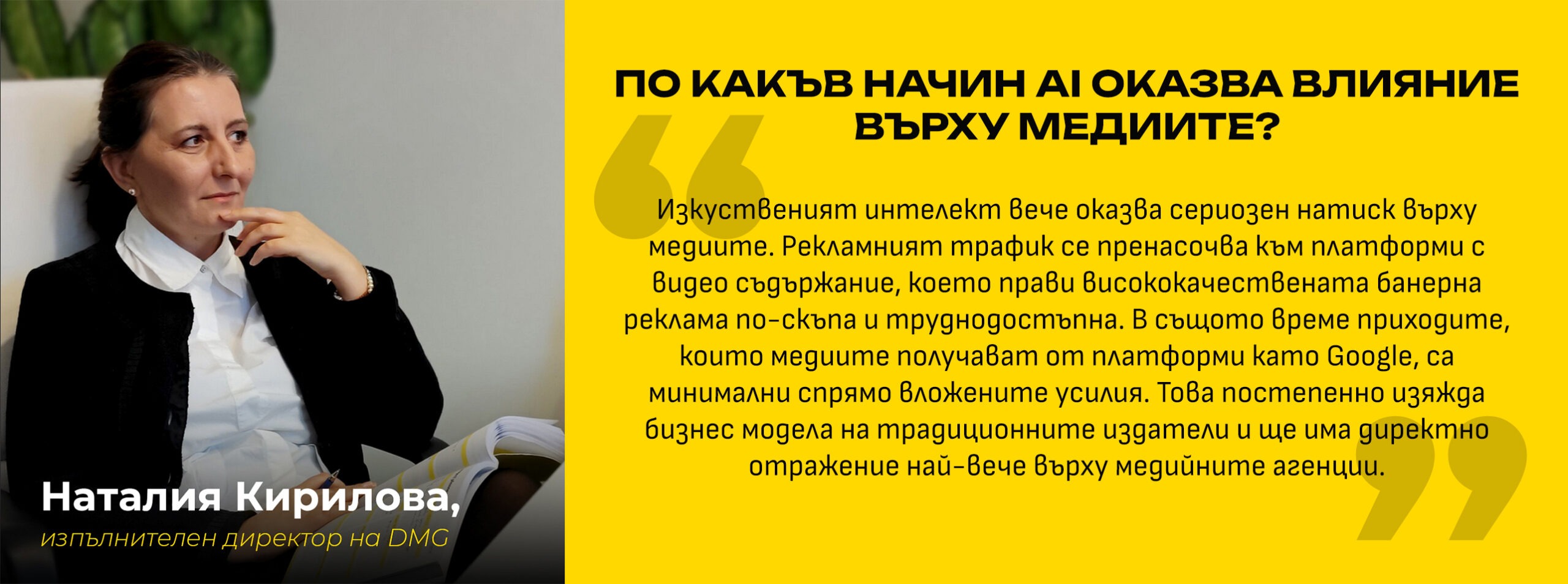
How does AI impact the media?
Artificial intelligence is already exerting serious pressure on the media. Advertising traffic is being redirected to platforms with video content, making high-quality banner advertising more expensive and harder to reach. At the same time, the revenue that media outlets receive from platforms like Google is minimal compared to the effort invested. This is gradually eating away at the business model of traditional publishers and will have a direct impact primarily on media agencies.

Will we see new leaders among current global platforms? YouTube, TikTok, and Instagram Reels will remain leading channels. However, we should not overlook LinkedIn, which is emerging as a strong B2B channel with growing importance for corporate campaigns. In our country, CTV will continue to be a “black hole” in the market – there will be huge demand and almost no supply outside of YouTube.
Will all of this shrink advertising budgets?
Surprisingly or not, despite the instability, the forecast is for slow but steady growth of 3–5% annually in Bulgaria over the next 2–3 years. It will be driven mainly by digital formats. Traditional media will continue to lose share, especially print. The introduction of the euro and inflation will also be a factor in increasing the volume of the market.
And how are clients reacting to so many new developments?
The pressure for higher profits on clients is serious. Therefore, they will become increasingly sensitive to ROI and will demand better measurement of results, especially in conditions of economic uncertainty. Global companies are regularly undergoing restructurings, which is another indicator of instability and unpredictability at a macroeconomic level.
How do consumers behave in this unpredictable, technology-dominated market?
Consumer engagement is dropping, and attracting and retaining their attention will become increasingly difficult. Metrics such as landing page views, engagement, app downloads, and lead generation will become harder to achieve. Even a regular click is already becoming expensive. Consumers are tired of interacting with brands and are looking for authenticity and the human factor.
Everything said so far leads us to think that the advertising industry is facing significant changes.
That’s right, in order to maintain its positions, the market will look for new ideas, new challenges. Advertisers will be open to “testing” all kinds of crazy ideas just to stand out from the competition. Along with this, I expect major brands to continue the trend of building in-house departments (media, creative, production). This is a trend that will reverse in a few years.